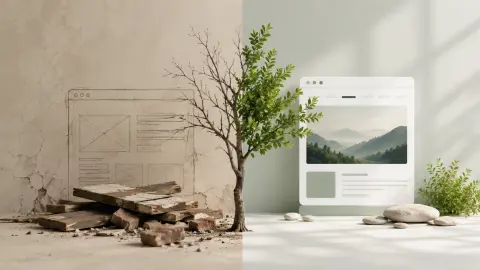

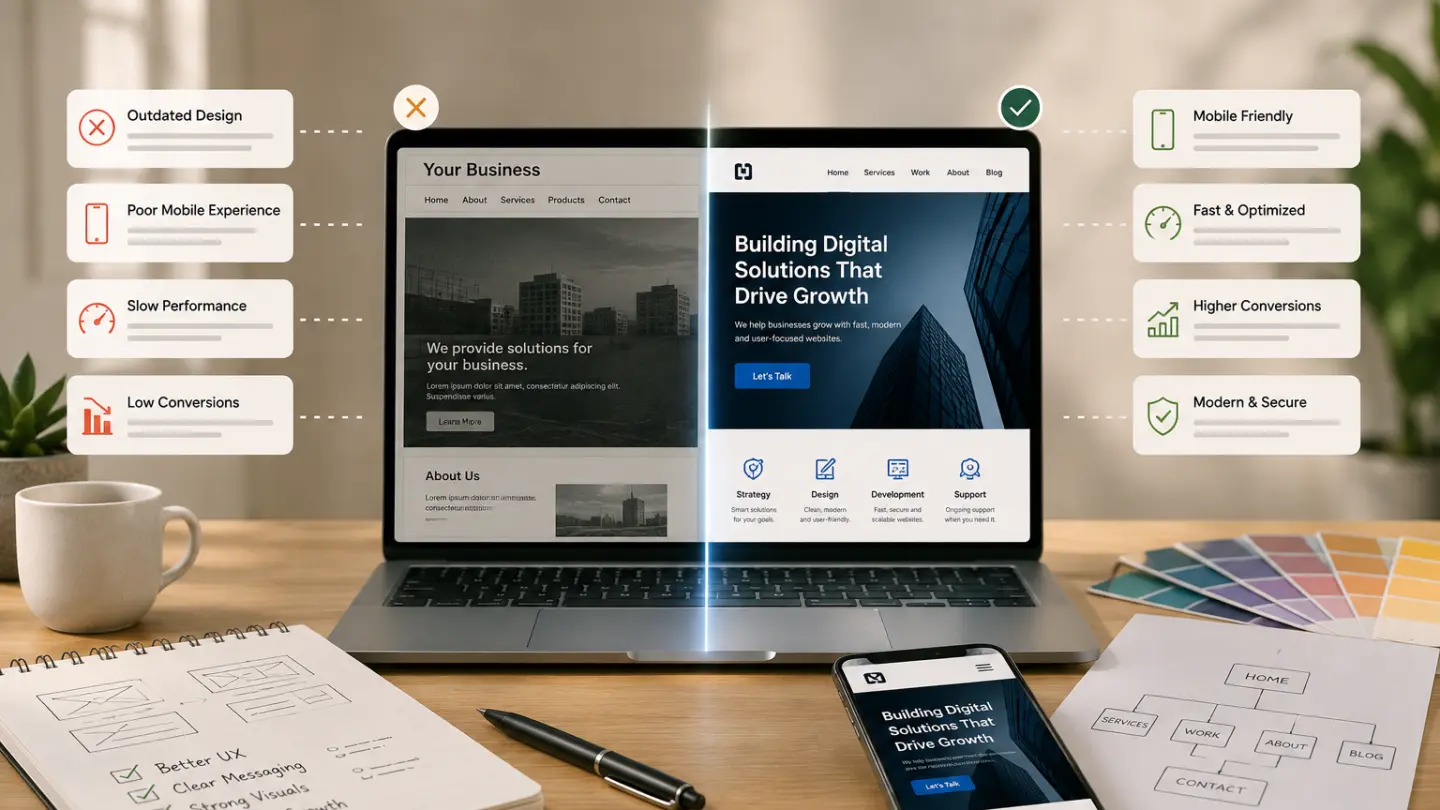
A website does not need to look obviously broken to be outdated.
It may still load. The contact form may still work. Your logo may still look fine. Customers may even continue using it.
But underneath that surface, the website may be making it harder for people to understand your business, trust your company, find you through search, or take the next step.
A redesign should not happen simply because a website is “old.”
It should happen when the current website is no longer doing its job well enough.
Here are seven signs that point in that direction.
1. Your Website No Longer Reflects the Business
Businesses evolve faster than websites.
You may have launched with three services and now offer twelve. Your target customers may have changed. The company may have moved upmarket, entered new industries, hired a larger team or developed a much stronger portfolio.
Yet the website still tells the story of the company from four years ago.
Common symptoms include:
- services that are missing or poorly explained
- outdated team information
- old positioning or messaging
- outdated screenshots and photography
- products that are no longer important
- a visual identity that no longer matches the brand
This creates more than a cosmetic problem.
A potential customer uses your website to form an impression of the company as it exists today.
If your business has matured but your website still looks like the company you used to be, the website is actively underselling you.
Sometimes this can be solved with new content. But when the structure itself was designed around an older version of the business, a redesign is usually cleaner.
For an established company, this is also where the original cost of a business website should be viewed in context: maintaining an outdated foundation can eventually cost more than rebuilding the parts that no longer fit.
2. The Mobile Experience Feels Like a Compromise
Having a website that technically “works on mobile” is no longer enough.
Try using your own website from a phone as if you were a new visitor.
Can you quickly understand what the company does?
Can you navigate comfortably with one hand?
Are buttons easy to tap?
Does important content appear early, or do visitors have to scroll through oversized banners before reaching anything useful?
Warning signs include:
- tiny text
- cramped navigation
- buttons too close together
- horizontal scrolling
- oversized popups
- awkward forms
- images that dominate the screen
- desktop layouts simply stacked vertically
Mobile design should not feel like a reduced version of desktop.
It should be considered as its own user experience.
For many businesses, the first interaction a potential customer has with the company will happen on a phone. If that experience is frustrating, they may never return on a larger screen.
3. Visitors Arrive, but They Don't Take Action
Traffic alone does not make a website successful.
If people are reaching the website but rarely:
- contact you
- request a quote
- book a consultation
- buy a product
- download a resource
- create an account
then the problem may not be traffic.
It may be the website.
There are many possible causes:
- unclear calls to action
- weak messaging
- confusing navigation
- insufficient trust signals
- poor page hierarchy
- overly complicated forms
- unclear service differentiation
- too many competing actions
A visitor should not have to solve a puzzle to understand what happens next.
Ask One Simple Question
Open an important page and imagine you know nothing about the company.
Within a few seconds, can you answer:
What does this company offer, why should I care, and what should I do next?
If not, conversion problems are unsurprising.
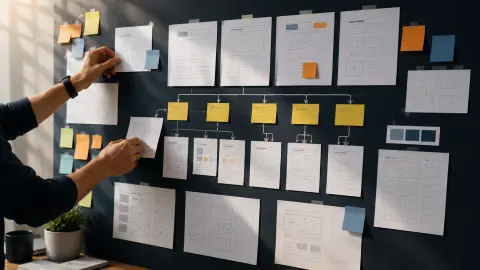
A redesign can address this by structuring pages around user intent rather than simply arranging information into attractive sections.
This is closely connected to what makes a website convert visitors into customers. A redesign should improve the path from interest to action, not merely update the visual style.
4. Updating Content Has Become Painful
A business website should not become frozen because everyone is afraid to edit it.
You may recognize the situation:
- adding a new service breaks the layout
- updating an image requires a developer
- new landing pages must be duplicated from old ones
- blog formatting is inconsistent
- editors paste content into rigid fields that no longer fit
- nobody remembers why certain plugins or components exist
This is often a sign that the content model and the actual business have drifted apart.
A CMS should make publishing easier. When the CMS begins dictating what the business is allowed to publish, the architecture needs attention.
A redesign is a good opportunity to rethink not only what visitors see, but also how the internal team manages the website.
That may mean better reusable components, cleaner content types, more appropriate permissions or an entirely different CMS.
If the CMS itself has become part of the problem, it may also be worth reassessing whether WordPress or custom development is the better foundation for the site's current requirements.
5. The Website Feels Slow and Heavy
Performance problems tend to accumulate gradually.
A website starts simple. Then analytics scripts are added. A chat widget appears. More plugins arrive. Marketing adds another tracking platform. Images get uploaded without optimization.
Eventually, the site feels noticeably heavier than it used to.
Typical symptoms include:
- slow initial loads
- large images
- layout shifting while the page loads
- delayed buttons or menus
- excessive animations
- large JavaScript bundles
- too many third-party scripts
Performance is not only an engineering concern.
It affects the experience of every person trying to use the site.
A redesign gives you an opportunity to question everything that has accumulated over time:
Do we still need this?
Removing unnecessary complexity can sometimes improve a website more than adding new features.
If performance is one of the main reasons for considering a redesign, it is worth first understanding why website speed matters for SEO, sales and user experience. Some sites can be improved through focused optimization without requiring a complete rebuild.
6. The Site Has Become a Collection of Patches
This is one of the clearest technical signs that a redesign may be justified.
Over time, websites often accumulate fixes:
“Don't touch that plugin.”
“That page uses the old template.”
“This integration only works if that setting stays enabled.”
“We added custom CSS to fix the previous custom CSS.”
Individually, none of these decisions seems serious.
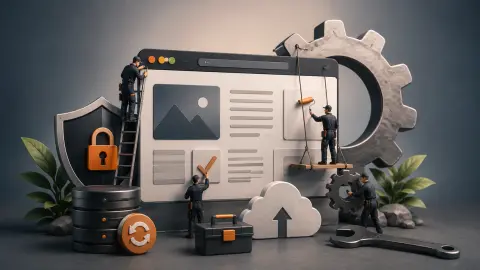
Together, they create technical debt.
You may have:
- duplicated components
- multiple design systems
- obsolete plugins
- abandoned integrations
- inconsistent templates
- undocumented customizations
- dependencies nobody wants to update
At some point, continuing to patch the system becomes more expensive and risky than rebuilding the problematic parts properly.
A redesign is not necessarily about replacing everything.
Sometimes the correct strategy is to preserve the parts that work and rebuild only the layers that have become difficult to maintain.
7. You Avoid Sending People to Your Own Website
This is surprisingly common.
A salesperson sends a PDF instead of a service page.
A founder explains the company manually because the homepage does not explain it well.
Marketing sends campaign traffic directly to third-party platforms.
A team member apologizes before sharing the website:
“The site is a little outdated, but…”
That is a strong signal.
Your website should reinforce confidence in the business, not require an explanation.
If your team has stopped treating the website as a useful sales and marketing asset, the issue is larger than visual design.
A Redesign Does Not Mean Starting From Zero
One of the biggest misconceptions about redesign projects is that everything must be discarded.
Usually, that would be wasteful.
A good redesign begins by identifying what already works.
That might include:
- high-performing content
- pages with strong search visibility
- successful conversion paths
- useful integrations
- recognizable visual elements
- existing customer workflows
The objective is not to replace things simply because they are old.
The objective is to keep the value and remove the friction.
This is especially important for established websites with years of content and organic search history.
A redesign should preserve valuable URLs, search equity and proven content wherever possible rather than treating the existing website as disposable.
Before You Redesign, Define the Problem
Avoid beginning with:
“We want a more modern website.”
That is too vague.
Instead, identify concrete problems.
For example:
- visitors don't understand our services
- mobile conversion is poor
- our team cannot publish efficiently
- important pages load too slowly
- the site no longer reflects our positioning
- our current platform cannot support upcoming integrations
- the architecture has become difficult to maintain
These statements give the project direction.
They also make it possible to judge whether the redesign was successful after launch.
A redesign should solve measurable business and usability problems—not simply produce a different visual style.
Final Thoughts
A website redesign should not be treated like repainting an office every few years.
There is no universal expiration date.
Some websites remain effective for years because the architecture, content and design continue to support the business. Others become limiting very quickly because the company evolves beyond what they were built to handle.
The strongest reason to redesign is simple:
The gap between what your business needs from the website and what the current website can deliver has become too large.
When that happens, another patch may buy some time.
A thoughtful redesign can give the business a better foundation.