
Choosing how to build a business website often turns into a debate between WordPress and custom development.
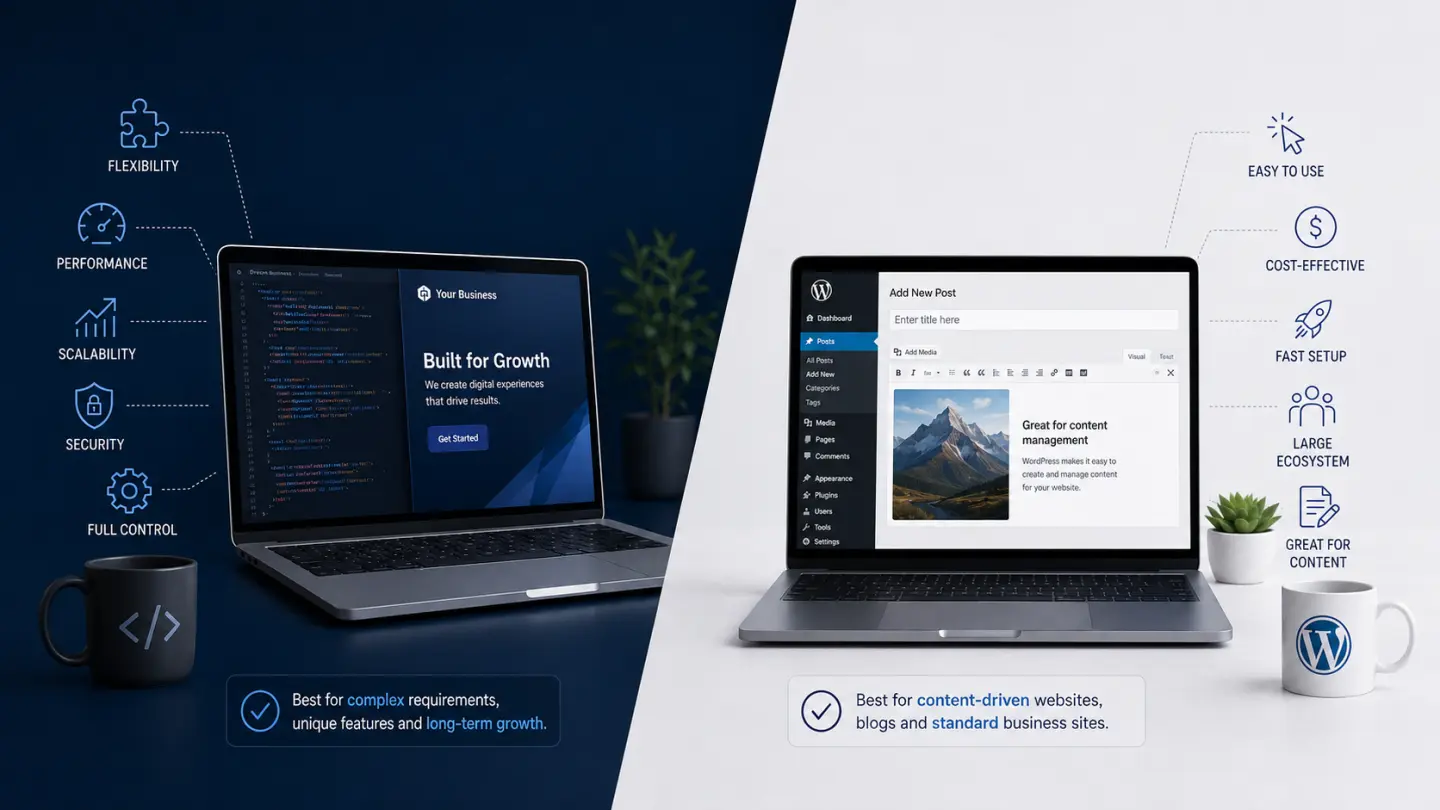
WordPress is widely available, has a huge ecosystem, and can get a business online relatively quickly. Custom development offers more control and can be designed around exactly how a company operates.
But the decision is not as simple as:
WordPress is cheap. Custom development is expensive.
Nor is it:
WordPress is basic. Custom development is professional.
Both can produce excellent websites. Both can also produce terrible ones.
The better question is what your website actually needs to do.
First, “Custom Website vs. WordPress” Is Not Quite Accurate
There is an important distinction worth making before comparing the two.
A WordPress website can itself be completely custom-designed and custom-developed.
You can build:
- a custom WordPress theme
- custom blocks
- custom post types
- custom integrations
- purpose-built admin functionality
without relying on a purchased template.
So when businesses talk about choosing between “WordPress” and “custom,” what they usually mean is:
WordPress as the underlying CMS versus a purpose-built website or web application developed with a framework such as Laravel, Django, Rails, or another technology.
That is the comparison we are making here.
When WordPress Makes Sense
WordPress is particularly strong when the website is primarily about publishing and managing content.
Think about a professional services company with:
- a homepage
- service pages
- industry pages
- case studies
- team profiles
- blog articles
- FAQs
- contact forms
Most of these pages are content-driven. Editors need to update copy, add new articles, change images, and create pages without involving a developer every time.
That is exactly the kind of problem WordPress was designed to solve.
WordPress Is Often a Good Fit When:
- content editors need significant control
- blogging or publishing is an important part of the website
- functionality is relatively standard
- the project has a moderate budget
- the business wants access to a large ecosystem of existing integrations
- marketing teams frequently create or edit pages
- development speed matters
For many small and medium-sized businesses, there is nothing inherently inferior about this approach.
A properly developed WordPress website can be fast, secure, scalable enough for substantial traffic, and highly customized.
For businesses working within a defined project budget, the broader cost of a small business website should also be considered alongside the platform decision.
Where WordPress Starts Becoming Awkward
Problems usually appear when a website gradually turns into something it was never intended to be.
Imagine starting with a simple company website.
Later, the business wants:
- customer accounts
- custom quotation workflows
- complex product configuration
- internal dashboards
- external API integrations
- advanced permissions
- subscription logic
- proprietary business rules
It is often technically possible to add these features to WordPress.
The more important question is whether you should.
A platform being capable of doing something does not automatically make it the right architecture for doing it.
A site built from dozens of plugins, custom hooks, workarounds, and interconnected extensions can become increasingly difficult to maintain.
At some point, you are no longer using WordPress primarily as a content management system. You are trying to turn it into a custom software platform.
That is usually where purpose-built development begins to make more sense.
When Custom Development Is the Better Choice
Custom development gives the development team control over the application's architecture from the beginning.
Instead of adapting the business requirements around an existing CMS, the software can be structured around those requirements.
This becomes valuable when the website contains significant business logic.
For example, imagine a distributor that wants customers to:
- log into an account
- see customer-specific pricing
- search thousands of products
- request custom quotations
- view previous orders
- synchronize stock with an ERP
- send approved orders into an accounting system
Calling this a “website” does not really describe the project anymore.
It is a business application with a public website attached to it.
A framework such as Laravel may provide a much cleaner foundation for that kind of system.
The Trade-Off: Flexibility vs. Development Cost
Custom development provides control, but that control comes with additional work.
With WordPress, many common capabilities already exist.
Need user management? It exists.
Need an editor? It exists.
Need media management? It exists.
Need an SEO interface? Mature tools are available.
With a custom application, these capabilities may need to be designed, implemented, or integrated.
That generally means a higher initial development cost.
But the economics can reverse as complexity grows.
A business may initially save money by using an off-the-shelf platform, only to spend significantly more later maintaining workarounds and incompatible extensions.
So the comparison is not simply about initial price.
It is about:
- development cost
- maintenance cost
- flexibility
- operational efficiency
- future requirements
- expected lifespan
The cheapest initial implementation is not necessarily the solution with the lowest total cost of ownership.
What About Performance?
You will often hear claims such as:
“Custom websites are always faster than WordPress.”
That is too simplistic.
A poorly engineered custom website can be slow.
A well-configured WordPress website can be extremely fast.
Performance depends on factors such as:
- frontend architecture
- image optimization
- caching
- database queries
- hosting
- JavaScript usage
- third-party scripts
- plugin quality
Where custom development does have an advantage is control.
A developer can avoid unnecessary systems and build only what the application actually requires.
WordPress, by contrast, may carry functionality that a particular website does not need, especially when page builders and large plugin stacks are involved.
The underlying platform is only one part of the equation. Website speed affects SEO, conversions and user experience, regardless of whether the site is built with WordPress or a custom framework.
Security Works the Same Way
Neither approach is automatically secure.
WordPress has the advantage of a mature platform with regular security updates, but its enormous plugin ecosystem creates additional variables.
A neglected WordPress installation containing outdated plugins can become a serious risk.
Custom software avoids the WordPress plugin ecosystem, but introduces another responsibility: your development team now owns more of the security implementation.
Security depends far more on maintenance and engineering practices than on the platform name printed underneath the website.
A Simple Way to Choose
Rather than starting with technology, look at the project itself.
WordPress Is Likely the Better Starting Point If:
- most functionality revolves around content
- editors need significant publishing freedom
- requirements are relatively conventional
- existing integrations solve most needs
- budget and speed are important considerations
Custom Development Deserves Serious Consideration If:
- the website contains proprietary workflows
- business rules are complex
- multiple systems must communicate
- users have sophisticated accounts or permissions
- the product will evolve substantially
- the website is becoming operational software
There is also a middle ground.
A business can use WordPress for its marketing website while a separate custom application handles customer accounts, operations, or other specialized functionality.
Architecture does not need to be ideological.
For commerce-focused projects, the same principle applies when comparing Shopify, WooCommerce and custom e-commerce: the right platform depends on the operational requirements, not simply on which technology is more powerful.
Don't Choose a Technology Because an Agency Prefers It
This is one of the easiest mistakes to make.
A WordPress agency may recommend WordPress for nearly every project.
A Laravel development company could make the opposite mistake and recommend custom development even when WordPress would solve the problem more efficiently.
The technology should come after the requirements.
At Creafter, we prefer to think about the decision in this order:
- What does the business need?
- Who will manage the website?
- What needs to integrate with it?
- What might it need to become?
- What is the simplest architecture that can support those requirements well?
Only then should the technology be selected.
This also matters when an existing website has accumulated years of plugins, workarounds and architectural compromises. In that situation, it may be useful to evaluate the signs that a business website needs a redesign rather than continuing to extend an unsuitable foundation.
So, Which One Should You Choose?
For a straightforward business website focused on content, marketing, SEO, and lead generation, WordPress can be an excellent choice.
If your project involves unusual workflows, extensive integrations, proprietary functionality, or software-like behavior, custom development may provide a cleaner and more sustainable foundation.
And sometimes the correct answer is a combination of both.
The goal is not to choose the most powerful technology available.
It is to choose the least complicated solution that properly solves the problem—without creating unnecessary limitations later.