
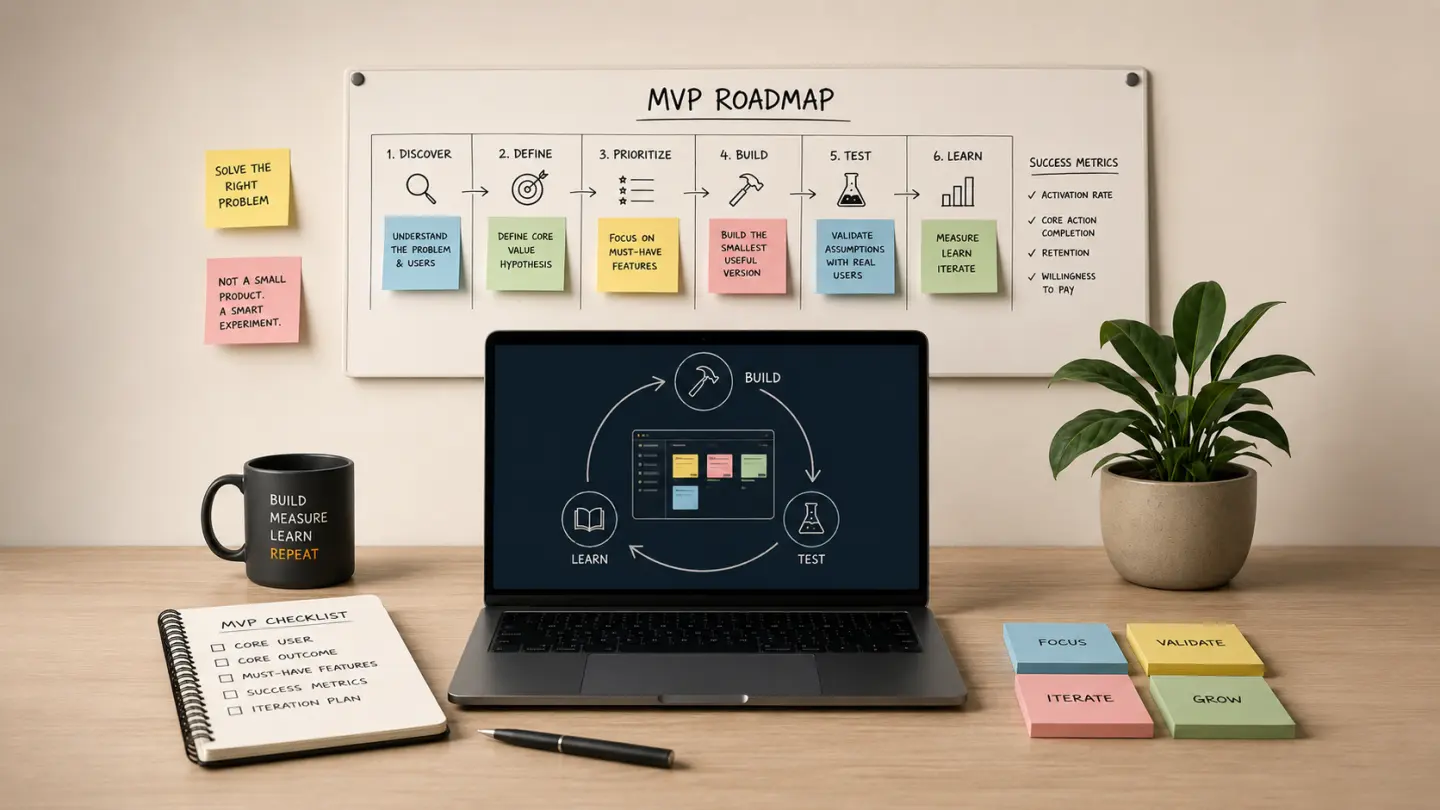
Building an MVP is supposed to reduce risk.
Yet many MVP projects do the opposite.
The original idea may begin as a focused product with three important capabilities. Then another feature seems useful. Someone suggests an admin dashboard. A stakeholder asks for advanced reporting. Integrations get added “because we will need them eventually.”
Soon the supposedly minimal product is taking six months to build.
The problem is usually not development.
It is failing to decide what the first version is actually supposed to prove.
A good MVP is not the smallest product you can build. It is the smallest product that can answer an important business question.
That distinction can save a significant amount of time and money.
Start With the Risk, Not the Feature List
Most teams begin MVP planning by writing down features.
That is understandable, but it skips an important question:
What are we uncertain about?
For example:
- Will customers pay for this?
- Will users understand the workflow?
- Does the problem happen frequently enough?
- Can we acquire customers economically?
- Can the business deliver the service behind the product?
- Will users trust the platform with this process?
- Can an integration work reliably enough?
- Does the proposed workflow actually save time?
These are assumptions.
Your MVP should be designed to test the assumptions that could invalidate the business if they turn out to be wrong.
Imagine two features:
Feature A: automated invoice exports.
Feature B: the core workflow customers are expected to pay for.
Feature A may eventually be necessary.
But if nobody wants Feature B, invoice exports do not matter.
That is why prioritization should follow business risk, not simply development convenience.
An MVP Is Not a Bad Version of the Final Product
“Minimum” is often misunderstood.
It does not mean:
- broken layouts
- confusing navigation
- unreliable code
- poor mobile usability
- unfinished onboarding
- security shortcuts
- random placeholder content
Those things do not make a product minimal.
They make it difficult to evaluate.
If users abandon the MVP because the interface is confusing, you may conclude that the idea is bad when the real problem is execution.
The first version can have fewer capabilities while still being coherent and usable.
Think of the distinction as:
Reduce scope, not quality.
A focused product that performs one valuable workflow well is usually a better MVP than a large product where twenty features feel unfinished.
Define the Core User and Core Outcome
An MVP becomes difficult to control when it tries to serve too many people.
Suppose you are building software for service companies.
Potential users might include:
- business owners
- sales teams
- operations staff
- customers
- accountants
- managers
- external partners
Eventually, the product may need to support all of them.
The MVP probably should not.
Instead, define one primary user.
Then define the outcome that user needs.
For example:
A sales representative should be able to create an accurate customer quotation in under five minutes.
That statement is far more useful than:
“The MVP needs CRM, quotations, reporting, permissions and integrations.”
The first describes a result.
The second describes a collection of software.
Map the Smallest Complete Workflow
Once the core outcome is clear, map the workflow from beginning to end.
Suppose the product helps distributors create quotations.
A full future platform might include:
- CRM synchronization
- customer accounts
- product catalog management
- inventory synchronization
- negotiated pricing
- quotation generation
- internal approvals
- PDF generation
- electronic signatures
- order conversion
- accounting integration
- reporting
Trying to build all twelve before launch would defeat the purpose of an MVP.
Instead, ask:
What is the smallest complete journey that delivers the core value?
Perhaps version one only needs:
- select a customer
- select products
- calculate the correct price
- create a quotation
- export or send it
That is a complete workflow.
Reporting can wait.
Electronic signatures can wait.
Automated accounting synchronization can wait.
The product already allows you to test whether faster quotation generation creates value.
Separate Must-Have From “Obviously We'll Need It”
One of the most expensive phrases in product development is:
“We might as well build it now.”
Sometimes that is sensible.
Often it is how scope expands without discipline.
A useful feature classification is:
Must Have
Without this capability, the core workflow does not function.
Should Have
Important soon, but the MVP can still test its central assumption without it.
Later
Useful once the product has evidence, customers or operational scale.
Not Yet
Interesting idea with no current justification.
The important part is not the labels.
It is forcing every feature to justify its place.
If removing a feature does not prevent the MVP from testing its primary assumption, that feature deserves scrutiny.
Avoid Building Administration for Problems You Do Not Have Yet
Admin systems are a surprisingly common source of MVP bloat.
Teams begin designing:
- advanced permission matrices
- audit dashboards
- bulk-management tools
- configurable workflows
- custom report builders
- complex notification settings
- multiple administrative roles
before the product has ten users.
Some administration is necessary.
But early products can often tolerate manual operations behind the scenes.
For example, perhaps an employee manually approves new accounts during the first three months.
That may be less elegant than building an automated approval system.
It may also save two weeks of development.
If the product succeeds and account volume increases, automation becomes justified.
Do not automate a process simply because you expect it to become a problem someday.
Automate it when the expected value begins to justify the complexity.
Manual Work Can Be an MVP Feature
This sounds counterintuitive, especially when building software.
But a human can temporarily perform part of the system.
Suppose your future product will automatically analyze a customer's submission and generate a recommendation.
For the MVP:
- the customer submits the information
- your internal team reviews it
- the recommendation is created manually
- the customer receives the result through the product
From the customer's perspective, the core value is still being tested.
You can learn:
- whether customers submit the information
- whether they value the result
- what inputs are actually necessary
- which recommendations occur repeatedly
- which parts should eventually be automated
Only then do you invest in automation.
This approach is particularly useful when the automation itself would be expensive to build before demand has been validated.
Don't Build Your Own Version of Everything
An MVP should concentrate development effort on what makes the product different.
You probably do not need to build:
- authentication from first principles
- your own payment infrastructure
- an email delivery system
- cloud storage
- analytics infrastructure
- a video conferencing platform
- a generic CMS
- an entire e-commerce engine
unless one of those things is genuinely part of the product's competitive advantage.
Use mature services where appropriate.
The same principle applies more broadly when deciding whether your business really needs custom software.
Custom development is most valuable when it encodes the workflows, rules and experiences that generic software cannot provide—not when it recreates solved infrastructure for no reason.
Be Careful With Integrations in Version One
Integrations are easy to underestimate.
Connecting to an external platform may require:
- authentication
- field mapping
- synchronization rules
- error handling
- rate-limit management
- retries
- webhook processing
- data reconciliation
- permissions
- testing against external environments
And your team does not control the other platform.
Before adding an integration to an MVP, ask:
Does this integration test our product idea, or does it merely make operations more convenient?
If importing ten records manually each day allows you to validate the business for two months, that may be smarter than spending weeks automating the process immediately.
There are exceptions.
If the product's core promise is itself an integration, then obviously it belongs in the MVP.
Again, the core assumption determines the scope.
Design for Today's Scope Without Blocking Tomorrow
Avoiding overengineering does not mean ignoring architecture.
There is a difference between:
not building a future feature
and:
making today's implementation unnecessarily difficult to extend later.
Suppose the MVP has only one user role.
You do not necessarily need a sophisticated permissions engine.
But you also should not scatter assumptions such as if user == admin throughout hundreds of places in the codebase if multiple roles are an obvious near-term requirement.
Good MVP architecture leaves reasonable expansion paths without implementing the expansion itself.
This principle also applies when deciding between WordPress and custom development. The correct foundation should support what the product realistically needs to become without forcing you to build its entire future on day one.
Don't Let the Technology Stack Become the Project
Teams sometimes spend more energy debating technology than defining the product.
Should we use Laravel?
Should the frontend be React?
Do we need microservices?
Should everything be serverless?
Would Kubernetes make the architecture more scalable?
These can be legitimate engineering questions.
But they should follow the product requirements.
An MVP with no users rarely fails because it did not begin with enough infrastructure.
It fails because:
- nobody needs it
- the workflow is wrong
- the value proposition is unclear
- acquisition is too expensive
- users do not return
- the business model does not work
Choose technology that allows the team to build, maintain and iterate effectively.
Architecture should support validation, not become a substitute for it.
Set a Budget for Learning, Not Just Development
Suppose the available budget is $30,000.
The obvious temptation is to allocate almost all of it to building the most complete product possible.
That may be a mistake.
The MVP also needs to be:
- launched
- observed
- tested
- improved
- marketed
- supported
If the entire budget disappears before the first real customer uses the product, there is no room left to respond to what you learn.
A healthier approach might reserve part of the budget for post-launch iteration.
For example:
- initial discovery and product definition
- first MVP build
- launch and measurement
- one or more iteration cycles
The exact split depends on the project.
The principle does not:
The first launch should not consume all the resources required to learn from the first launch.
Decide What Success Looks Like Before Development
Without success criteria, MVP feedback becomes subjective.
One stakeholder says users seem interested.
Another says the product needs more features.
Someone else wants a complete redesign.
Instead, decide what signals matter before launching.
Depending on the product, you might measure:
- percentage of invited users who activate
- percentage completing the core workflow
- repeat usage
- quotation requests
- paid conversions
- time saved
- error reduction
- retention
- willingness to pay
- customer acquisition cost
- number of manual interventions required
The metric should connect directly to the assumption the MVP was designed to test.
If the goal was to determine whether companies will pay to automate quotation creation, page views are not the most important result.
Expect the MVP to Change
The purpose of an MVP is learning.
That means discovering that some assumptions were wrong is not necessarily failure.
Perhaps customers love the product but ignore a feature you thought was essential.
Perhaps the target market changes.
Perhaps users repeatedly request a workflow that was not originally planned.
Perhaps the product solves a slightly different problem better than the one you intended.
That information is valuable precisely because you discovered it before investing in the full product.
An MVP should create a feedback loop:
Build → Launch → Observe → Learn → Prioritize → Improve
Not:
Build → Build More → Build More → Finally Show Someone
The Most Expensive MVP Is the One That Never Becomes Minimal
Feature creep usually sounds reasonable one feature at a time.
“While we're here…”
“It wouldn't take much longer…”
“We'll definitely need this later…”
“Competitor X already has it…”
Individually, each addition may appear harmless.
Together, they can transform a focused MVP into a large speculative software project.
A useful question whenever scope expands is:
What new assumption will this feature allow us to test?
If nobody can answer, the feature may belong after launch.
Final Thoughts
Planning an MVP is an exercise in deciding what not to build.
The objective is not to predict the finished product perfectly.
It is to create enough of the product to test whether the underlying idea deserves further investment.
Define the core user.
Identify the riskiest assumption.
Build the smallest complete workflow that can test it.
Use existing infrastructure for solved problems.
Delay automation where manual work can temporarily provide the same learning.
Leave budget for iteration.
And measure what happens after launch.
A successful MVP does not prove that your original plan was correct.
It gives you enough real-world evidence to decide what should be built next.