
Most businesses do not need custom software.
That is worth saying first.
There are mature products for accounting, customer relationship management, e-commerce, project management, marketing, payroll, inventory and hundreds of other business functions.
If an existing product solves the problem well, building your own version usually creates cost and responsibility without enough benefit.
Custom software becomes interesting when the problem is no longer:
“Which software should we buy?”
and starts becoming:
“Why are we changing the way our business works just to fit the software?”
That is an important distinction.
Custom Software Should Solve a Business Problem
A custom application should not begin with a feature list.
It should begin with friction.
Maybe employees copy the same information between three systems every day.
Maybe customers cannot complete an important process without calling someone.
Maybe quotations take hours because pricing depends on rules that existing software cannot represent.
Maybe your team has built an unofficial operating system from spreadsheets, emails, shared documents and manual approvals.
Those are not necessarily software problems individually.
But when they create enough recurring cost, delay or risk, custom software can become a business solution rather than a technical luxury.
1. Your Business Depends on a Workflow That Standard Software Cannot Handle
Off-the-shelf software is designed around common workflows.
That is precisely why it is economical.
A CRM might assume that every sales opportunity follows roughly the same stages. An inventory platform might assume products are priced and stocked in a conventional way. An e-commerce system may expect customers to follow a familiar product-to-checkout journey.
Sometimes your business does not work that way.
Imagine a distributor where an order must:
- identify the customer's negotiated price list
- check availability across several warehouses
- calculate commercial terms
- request internal approval above a threshold
- create an ERP transaction
- notify the correct account manager
- provide the customer with updated order status
If every stage requires another workaround, spreadsheet or manual intervention, the workflow itself may justify purpose-built software.
This is similar to the point where an e-commerce project becomes business software rather than simply an online store.
2. Your Team Is Performing the Same Manual Work Repeatedly
Repetition is one of the strongest signals for automation.
Consider tasks such as:
- copying information between systems
- generating recurring reports manually
- preparing quotations from spreadsheets
- matching records from different platforms
- sending predictable status emails
- creating the same documents repeatedly
- checking whether predefined conditions have been met
- assigning work based on fixed business rules
A single manual task taking ten minutes may not justify custom development.
But ten minutes multiplied by several employees, several times per day, hundreds of days per year is a different calculation.
The useful question is:
How much time does this process consume across the entire business?
Custom software can be valuable when it removes recurring operational work instead of merely making the interface look better.
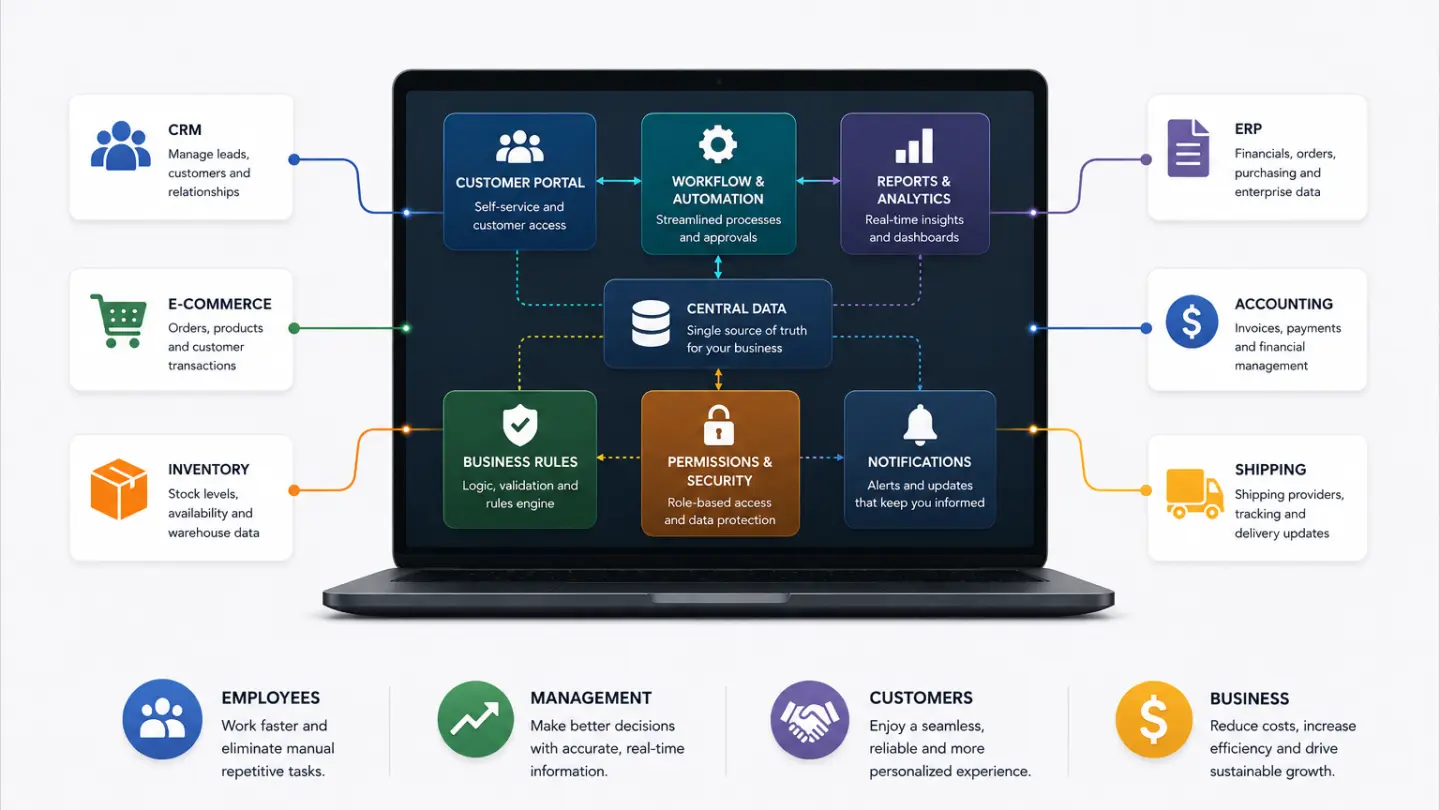
3. Your Existing Systems Do Not Communicate Properly
Many businesses already have the software they need.
The real problem is that the systems operate independently.
For example:
- the website collects leads
- the CRM manages sales
- the ERP manages orders
- accounting handles invoices
- a warehouse system tracks inventory
- another platform manages shipping
Employees become the integration layer.
They export CSV files, copy order numbers, compare reports and move information manually between platforms.
Before replacing everything, it is worth asking whether the better solution is custom integration software.
A purpose-built middleware layer, internal application or API integration can sometimes solve the problem without replacing the major platforms the business already uses.
Custom development does not always mean building an entire system from zero.
Sometimes it means connecting existing systems properly.
4. Spreadsheets Have Become Critical Infrastructure
Spreadsheets are extraordinarily useful.
They are also capable of quietly becoming business-critical software.
You may have a spreadsheet containing:
- complex pricing formulas
- inventory planning
- sales forecasts
- customer-specific rules
- scheduling logic
- approval status
- operational calculations
At first, this is efficient.
Then the spreadsheet grows.
More employees use it. Copies appear. Formulas become increasingly difficult to understand. Someone accidentally overwrites a cell. Nobody is completely sure which version is current.
Eventually the company is depending on software architecture—it just happens to be implemented inside a spreadsheet.
That is often a good moment to investigate whether the process deserves a proper application.
The purpose is not to eliminate spreadsheets.
It is to recognize when a spreadsheet has become too important, too complex or too fragile for the responsibility it carries.
5. Customers Need an Experience Your Current Platform Cannot Provide
Custom software can also become necessary on the customer side.
A standard website may be sufficient when customers simply need information and a contact form.
Requirements become more interesting when customers need to:
- log into an account
- access customer-specific information
- view negotiated pricing
- track projects or orders
- upload documents
- request quotations
- manage subscriptions
- collaborate with your team
- access reports
- complete multi-stage workflows
At that point, you may be building a customer portal or digital product, not simply adding another website page.
This is also why choosing between WordPress and custom development should depend on what the system actually needs to become.
A content management system may be excellent for publishing pages while still being the wrong foundation for complex operational software.
6. Your Competitive Advantage Depends on the Process
This is one of the strongest arguments for custom development.
Suppose every company in your industry uses roughly the same software.
If your business also operates in roughly the same way, that may be perfectly fine.
But perhaps your advantage comes from:
- pricing faster than competitors
- producing unusually accurate quotations
- matching buyers and suppliers differently
- automating a complex approval process
- providing customers with better operational visibility
- processing information using proprietary rules
If the process itself creates competitive advantage, forcing it into generic software may remove some of that advantage.
In this situation, custom software can encode how your business works differently.
That does not automatically justify building it.
But it changes the economics significantly.
7. You Are Paying for Workarounds Instead of Solving the Problem
Off-the-shelf platforms often begin inexpensively.
Then requirements grow.
A plugin is added.
Then another subscription.
Then middleware.
Then a custom script.
Then someone manually fixes the exceptions.
Eventually the business has created a complex system without deliberately designing one.
Typical warning signs include:
- several applications performing overlapping jobs
- expensive subscriptions used for only one feature
- fragile integrations
- frequent CSV imports and exports
- manual reconciliation
- repeated exceptions
- employees maintaining unofficial workarounds
- important processes depending on one person knowing “how everything works”
At this point, comparing only the cost of custom software with the original software subscription is misleading.
You should compare it with the total cost of the current process.
When Custom Software Is Probably the Wrong Choice
Not every inconvenience deserves its own application.
Custom software is usually a poor investment when:
- a mature product already solves the requirement well
- the business process is still changing constantly
- the company has not yet validated whether the workflow is necessary
- the main motivation is simply wanting to “own the software”
- the budget does not include ongoing maintenance
- requirements are vague
- the problem occurs too rarely to justify automation
A $100 monthly SaaS subscription can be far smarter than a $30,000 custom application if both produce essentially the same business result.
Custom software should create leverage, not simply ownership.
Start With the Process, Not the Technology
A common mistake is beginning with:
“We want a Laravel application.”
or:
“We need an AI platform.”
Those are implementation ideas, not business requirements.
A better discovery process starts with questions such as:
- What process are we trying to improve?
- Who performs it today?
- How often does it happen?
- Where are the delays?
- Where do errors occur?
- Which systems are involved?
- What information moves between them?
- Which rules determine what happens next?
- What would a successful outcome improve?
Only after those questions are understood should architecture and technology enter the discussion.
The same principle applies when choosing technology for a business website: the platform should follow the requirements, not the preferences of the development provider.
Custom Software Does Not Have to Replace Everything
One of the most expensive assumptions is that custom development requires rebuilding the company's entire technology stack.
Often it should not.
A custom system might sit between existing platforms.
For example:
Website → Custom Application → CRM → ERP
The custom application handles the proprietary workflow while mature third-party systems continue doing what they already do well.
This hybrid approach can reduce development cost, risk and maintenance responsibility.
The objective should be to build only the parts that create unique value.
Calculate the Cost of the Problem First
Before asking what custom software will cost, estimate what the current problem costs.
Consider:
- employee hours
- preventable errors
- lost sales
- delayed quotations
- duplicate data entry
- subscription costs
- manual reporting
- customer support overhead
- missed opportunities
- operational bottlenecks
If a problem costs the business $5,000 per year, a $100,000 software project probably needs a very strong additional justification.
If the same problem costs $200,000 per year and limits growth, the calculation looks completely different.
This is why custom software should be evaluated as an investment in operational improvement, not simply as a development expense.
Final Thoughts
The strongest reason to build custom software is not that existing tools are imperfect.
All software has limitations.
The stronger signal is that those limitations are now creating meaningful friction inside a process that matters to the business.
Your employees may be compensating with manual work.
Your customers may be encountering unnecessary steps.
Your systems may depend on fragile integrations.
Or the workflow that makes your company different may simply not fit inside generic software.
That is when custom development becomes worth investigating.
The question is not:
“Could we build this?”
Modern development makes the answer to that question surprisingly often yes.
The better question is:
“Would building this create enough business value to justify owning it?”
That is where a custom software project should begin.