

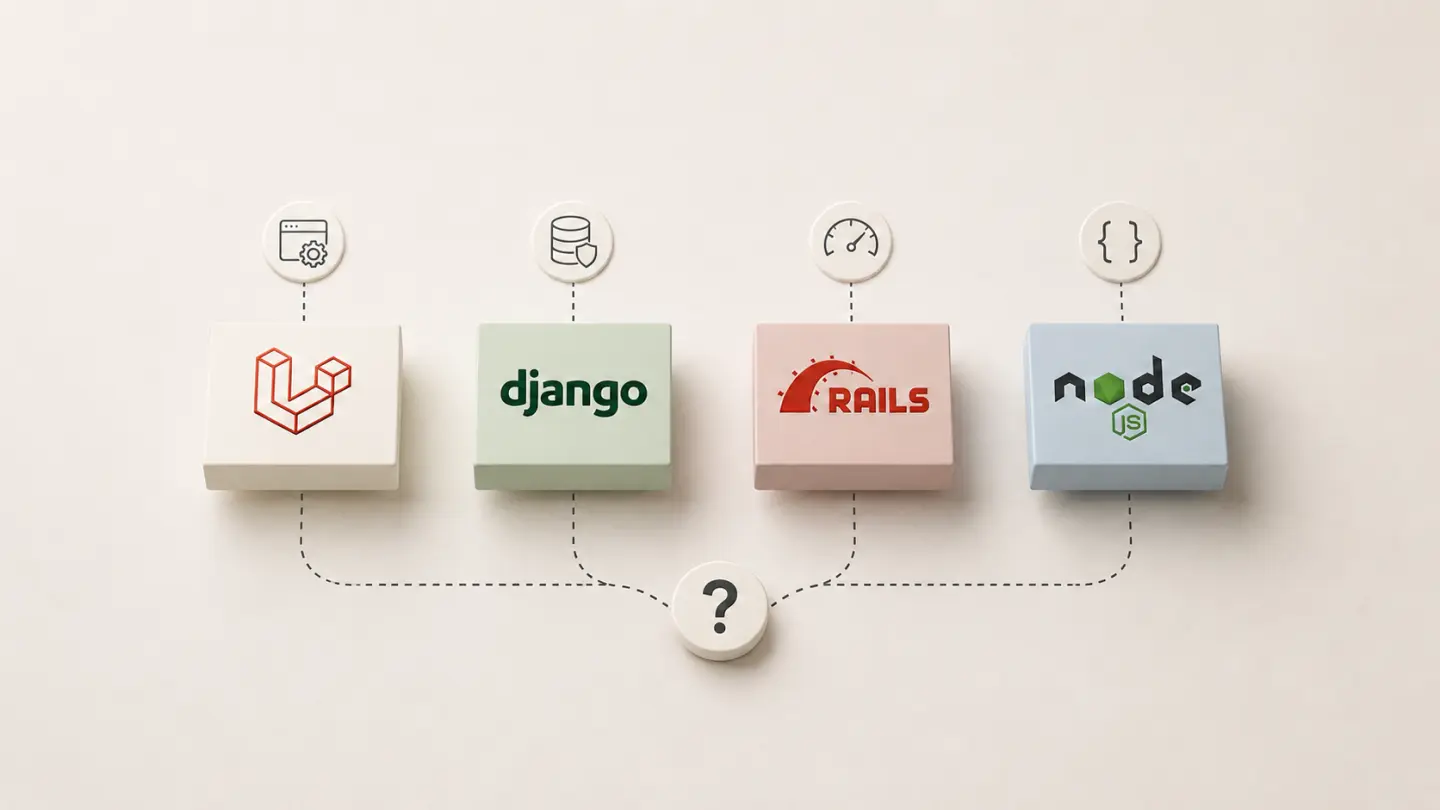
Software projects often begin with a technology question:
Should we use Laravel, Django, Rails or Node.js?
It sounds important because the technology stack will influence how the application is developed, deployed and maintained.
But for many business applications, it is not the first question that should be asked.
A better starting point is:
What does the product need to do, what constraints does it have, and what kind of team will maintain it?
Laravel, Django, Ruby on Rails and the Node.js ecosystem are all capable of powering substantial web applications.
The differences matter.
They just do not always matter in the way clients expect.
First, These Are Not Four Identical Things
Before comparing them, there is an important technical distinction.
Laravel, Django and Ruby on Rails are web application frameworks.
Node.js is a JavaScript runtime environment.
A Node.js application normally uses additional frameworks and libraries to provide the structure that Laravel, Django or Rails provide more directly.
So a technically precise comparison might look more like:
- Laravel
- Django
- Ruby on Rails
- Node.js with a framework such as Express, Fastify, NestJS or another application architecture
But businesses rarely need that level of terminology when choosing a development partner.
What matters is understanding that “Node.js” describes a broader ecosystem choice rather than one opinionated web framework.
Laravel: A Strong General-Purpose Business Application Framework
Laravel is a PHP web application framework with a broad set of capabilities for building modern applications.
Its ecosystem provides established approaches for:
- routing
- database access
- authentication
- authorization
- queues
- scheduled jobs
- caching
- notifications
- file storage
- API development
- testing
- background processing
That makes Laravel particularly comfortable for applications containing significant business logic.
Examples might include:
- customer portals
- internal business systems
- SaaS products
- B2B platforms
- workflow applications
- API-driven services
- custom e-commerce systems
- administration-heavy applications
Laravel also works well when a project needs both server-rendered interfaces and more interactive frontend components.
The important advantage is not that Laravel can perform some task the other technologies cannot.
It is that its conventions and ecosystem can make a broad class of business applications productive to build and maintain.
Django: Particularly Strong Where Python Is Already Valuable
Django occupies a similar broad web-application role in the Python ecosystem.
It includes mature tools for areas such as:
- data models
- database migrations
- authentication
- forms
- caching
- security
- internationalization
- administration
- testing
One particularly useful feature for many business systems is Django's built-in administration interface.
But the more strategic reason to consider Django is often the surrounding Python ecosystem.
Suppose a product is closely connected to:
- machine learning
- data analysis
- scientific computing
- document processing
- data pipelines
- Python-based automation
In that environment, Django can allow the web application and the rest of the technical organization to live comfortably in the same language ecosystem.
That does not mean every AI-related product should automatically use Django.
A product consuming an external AI API does not suddenly require its entire application to be written in Python.
The surrounding architecture matters more than the buzzword.
Ruby on Rails: Convention as a Productivity Tool
Ruby on Rails has long taken a strongly opinionated approach to web application development.
Its philosophy emphasizes ideas such as:
Convention over configuration.
Instead of asking developers to make every architectural decision from scratch, Rails provides conventions for how many common parts of a web application should work.
That can be extremely productive when the project fits those conventions.
Rails provides integrated systems around:
- database models
- migrations
- controllers
- views
- background jobs
- file storage
- testing
- real-time functionality
Its value is therefore not simply “Ruby syntax.”
It is the combination of Ruby and an application framework designed to give teams a coherent way to build web products.
For teams already productive with Rails, switching technologies merely because another framework is more fashionable would often create more cost than value.
A mature team using a familiar framework is often more valuable than a theoretically perfect technology choice used by an inexperienced team.
Node.js: JavaScript Beyond the Browser
Node.js allows JavaScript to run outside the browser, including on servers.
Its asynchronous, non-blocking I/O model makes it particularly natural for applications that spend significant time handling network activity and concurrent connections.
This has helped make Node.js a common foundation for:
- APIs
- real-time applications
- communication systems
- event-driven services
- backend-for-frontend systems
- streaming applications
- web application backends
It also offers an organizational advantage that can matter for some teams:
JavaScript or TypeScript can be used across both frontend and backend development.
That can reduce the number of language ecosystems a small team needs to maintain.
But Node.js also demonstrates why “technology stack” comparisons can become misleading.
A Node.js project might use:
- Express
- Fastify
- NestJS
- a custom architecture
- different ORMs
- different validation libraries
- different queue systems
Two Node.js projects may therefore look considerably more different from each other than two conventional Laravel or Rails applications.
Flexibility can be valuable.
It also means architectural discipline becomes especially important.
Can All Four Build the Same Application?
For a large percentage of conventional web applications, yes.
Imagine a SaaS product containing:
- user accounts
- organizations
- subscriptions
- dashboards
- reports
- file uploads
- notifications
- background jobs
- APIs
- an administration interface
There is no fundamental reason that this product could not be built successfully using Laravel, Django, Rails or a well-designed Node.js stack.
That is why asking:
“Which framework is the most powerful?”
usually produces an unhelpful discussion.
The application may never reach a point where framework capability is the limiting factor.
More likely constraints include:
- poor product decisions
- weak architecture
- inadequate testing
- excessive complexity
- insufficient infrastructure
- bad database design
- difficult-to-maintain code
- inappropriate third-party dependencies
Technology matters, but engineering quality exists above the framework layer.
Performance Is Rarely Determined by the Framework Name
Performance comparisons are another area where technology discussions become oversimplified.
You might hear:
“Node.js is faster.”
or:
“PHP cannot scale.”
or:
“Python is too slow.”
Statements like these remove almost all useful context.
Real application performance depends on many layers:
- database design
- query efficiency
- caching
- network latency
- external APIs
- frontend behavior
- asset delivery
- background processing
- infrastructure
- architecture
- traffic patterns
A poorly designed application can be slow in any technology.
A carefully engineered application can support substantial workloads using any of these ecosystems.
The same principle applies to public-facing websites: website speed depends on the complete system, not simply the framework listed in the project's dependencies.
Scalability Should Be Discussed With Numbers
“We need something scalable” is one of the least useful software requirements.
Scalable to what?
1,000 users?
100,000 users?
10 million requests per day?
Do users generate heavy reports?
Upload videos?
Maintain real-time connections?
Run computational workloads?
Mostly read cached content?
Different workloads create different bottlenecks.
Before rejecting or selecting a technology because of scalability, define the expected workload.
Otherwise, teams can spend significant money solving scale problems they do not have.
This is particularly dangerous during early product development. When planning an MVP, infrastructure designed for hypothetical massive scale can consume time that should be spent validating the product.
Developer Availability Does Matter
Technology is not only code.
It is also people.
A framework may be technically suitable while still being an impractical choice if the company cannot recruit or retain developers who understand it.
Questions worth considering include:
- Does the current team know the ecosystem?
- Can additional developers be hired?
- Is documentation mature?
- Are important libraries maintained?
- Can another team take over the project later?
- Does the organization already operate applications in this ecosystem?
A company with an experienced Python engineering team may have a strong reason to prefer Django.
A company operating several Laravel applications may benefit from keeping another business system inside the same ecosystem.
A product team already standardized around TypeScript may find a Node.js architecture operationally attractive.
Consistency across an organization has value.
Ecosystem Matters More Than Language Benchmarks
Framework decisions are often discussed as programming-language contests.
PHP versus Python.
Ruby versus JavaScript.
That misses much of what developers actually work with.
A production application depends on an ecosystem:
- frameworks
- libraries
- package management
- testing tools
- deployment systems
- monitoring
- documentation
- security practices
- developer knowledge
- community experience
The productive question is therefore not:
Which language wins?
It is:
Which ecosystem allows this team to build and operate this product reliably?
Existing Systems Can Influence the Decision
Greenfield projects offer more freedom.
Existing businesses often do not.
Suppose the company already has:
- several Python services
- a Laravel customer portal
- a JavaScript engineering team
- Ruby applications
- established deployment infrastructure
- internal libraries
- monitoring built around one ecosystem
Introducing another technology creates operational cost.
That cost may be justified.
But it should be intentional.
Technology diversity is useful when different problems genuinely benefit from different tools.
It is less useful when every new project chooses a framework based on whichever technology happens to be fashionable that year.
Architecture Often Matters More Than Framework Selection
Consider two teams building the same application.
Team A chooses the “perfect” framework but creates:
- tightly coupled modules
- unclear responsibilities
- duplicated business logic
- no automated tests
- fragile integrations
- undocumented deployment procedures
Team B chooses a perfectly ordinary framework but creates:
- clear domain boundaries
- maintainable code
- reliable tests
- observable integrations
- sensible database structures
- documented operations
Which application would you rather inherit?
The framework influences the development experience.
Architecture influences whether the application remains understandable as the business changes.
This becomes especially important when custom software is supporting core business workflows.
Don't Choose Technology for Marketing
Clients sometimes request a particular technology because they have heard that it is:
- modern
- scalable
- enterprise-ready
- AI-ready
- faster
- more secure
Those words mean very little without context.
Likewise, development companies should not recommend a framework simply because it is the framework they want to sell.
This is the same mistake businesses make when assuming one platform must always win the WordPress versus custom development decision.
Technology should follow the requirements.
Not the sales pitch.
When the Technology Stack Really Does Matter
There are situations where the choice becomes strategically important.
For example:
Existing Team Expertise
Using the technology your team already understands can dramatically reduce delivery and maintenance risk.
Specialized Ecosystem Requirements
A product tightly integrated with Python-based data or machine-learning systems may reasonably favor Python.
Real-Time or Event-Heavy Systems
Certain architectures may make asynchronous and event-driven ecosystems especially attractive.
Existing Infrastructure
Standardizing around technologies your organization already deploys and monitors can simplify operations.
Hiring Strategy
Long-term developer availability may influence the decision.
Integration Constraints
Legacy systems, SDK availability or vendor libraries may make one ecosystem substantially easier to work with.
Product Architecture
Some products simply fit the conventions of one framework more naturally than another.
These are meaningful reasons.
“Company X uses framework Y” usually is not.
A Better Technology Selection Process
Instead of beginning with a framework comparison, begin with the product.
Ask:
- What are we building?
- Who will use it?
- What are the core workflows?
- What systems must it integrate with?
- What workload do we realistically expect?
- What security or compliance requirements exist?
- Who will develop it?
- Who will maintain it in three years?
- What technical expertise already exists in the organization?
- Which architecture solves these requirements with the least unnecessary complexity?
Only then compare technology options.
Sometimes Laravel will be the strongest fit.
Sometimes Django.
Sometimes Rails.
Sometimes a Node.js architecture.
And sometimes the sensible answer is simply:
Use the technology the capable team already knows well.
Final Thoughts
The technology stack matters.
But it is rarely the reason a good product succeeds.
Customers do not care whether their quotation was generated by PHP, Python, Ruby or JavaScript.
They care that it is correct.
They care that the application is reliable.
They care that the workflow is understandable.
They care that their data is safe.
They care that the product solves the problem.
Choose technology seriously—but keep it in perspective.
The best stack is not the one that wins the most comparisons. It is the one that lets the right team build, operate and evolve the right product with the least unnecessary complexity.